

The Jill Carroll Story – Part 1: The kidnapping
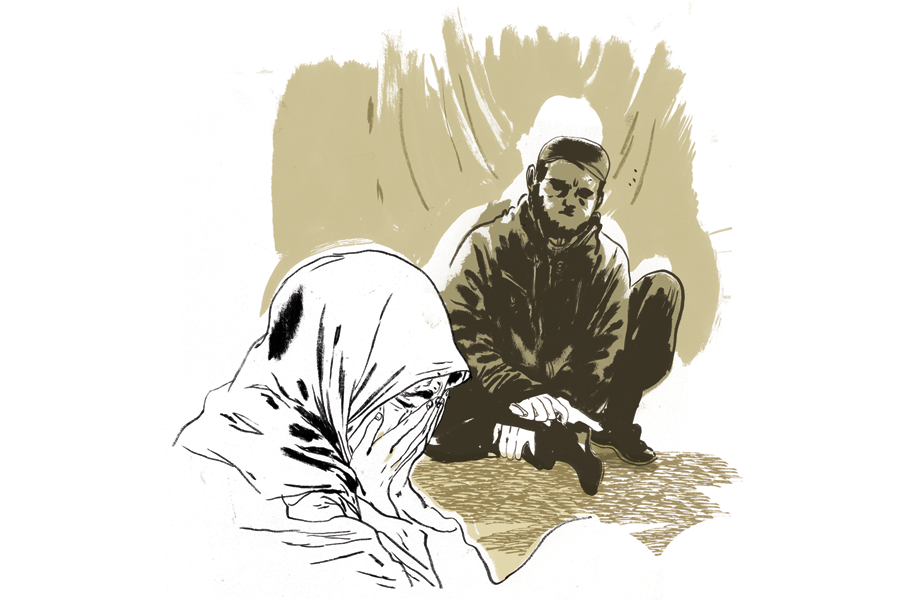
My chief captor had an idea about how to prod the US government into action: another video.
He said this one would be different, and left.
I turned to the two guards sitting on cushions a few feet away and started to panic. Really, really panic.
"Oh my God, oh my God, they're going to kill me, this is going to be it. I don't know when but they're going to do it," I thought.
I crawled over to Abu Hassan, the one who seemed more grown-up and sympathetic. His 9mm pistol was by his side, as usual.
"You're my brother, you're truly my brother," I said in Arabic. "Promise me you will use this gun to kill me by your own hand. I don't want that knife, I don't want the knife, use the gun."
I started to cry hysterically. By now I'd been held captive by Iraqi insurgents for six weeks. They'd given me a new hijab, a new name (Aisha), and tried to convert me to Islam. They'd let me play with their children – and repeatedly accused me of working for the CIA.
At night I'd fall asleep and be free in my dreams. Then I'd wake up and my situation would land on me like a weight. Every morning, it was as if I was kidnapped anew.
That particular morning I'd received a visit from Abu Nour, the most senior of my captors. As usual, the distinctive scent of his spicy cologne had announced his presence. As usual, I'd snapped my eyes to the ground to avoid seeing his face.
"We need to make a new video of you," he'd said, in his high-pitched, yet gravelly voice. "The last video showed you in good condition, and that made the government move slowly."
The British government had moved quickly, he'd said, after a video had shown hostage Margaret Hassan in bad condition. They wanted to push the US in the same way.
Margaret Hassan! An Irish aid worker married to an Iraqi, she'd been seized in Baghdad in October 2004, while on her way to work. Less than a month later, she was killed.
After the leader left, I sat and stared into the glowing metal of the propane heater, my knees drawn up under my red velveteen dishdasha. I was completely terrified.
If it was going to happen, I wanted it to be quick. So I crawled over to Abu Hassan and begged.
"I don't want the knife!" I sobbed.
Neither Abu Hassan nor his fellow guard – the blubbery, adolescent Abu Qarrar – really knew what to do about my outburst.
"We're not going to kill you. Why? What is this?" said Hassan.
His voice was flat and sounded insincere.
"Abu Qarrar, you speak English. You have to tell my family that I love them and that I'm sorry," I implored.
I sat against the wall of a house whose location I didn't know, under a window to an outside I couldn't walk through, and cried and cried.
• • •
In Baghdad, Jan. 7, 2006 was a sunny Saturday. For me it promised to be an easy day.
Not that my life in Baghdad was easy. Freelance journalism is a tough business everywhere. But I didn't want to sit in a cubicle in the US and write, as I had, about the Department of Agriculture food pyramid. Here I was living my dream of being a foreign correspondent – even if that meant sometimes living in a hotel so seedy it was best to buy your own sheets.
First up were some routine interviews of Iraqi politicians trying to form a new government. Three weeks before, the country had chosen its first democratically elected permanent government. But Sunni politicians were dismayed at how few seats they'd won.
Later, I planned to leave my virus-ridden laptop (stashed in the trunk) with a techie friend of my interpreter, Alan Enwiya.
Alan was vital to my newsgathering process. We had been a team for almost two years. We were also friends – it felt as if we were almost siblings – who'd worked through Iraq's difficult and increasingly dangerous conditions.
In our time together we'd eked out a living freelancing for the Italian news agency ANSA, USA Today, US News & World Report, and now The Christian Science Monitor. We had been threatened by militia members, mobbed after Friday prayers, and seen bullets rain down from passing police vehicles. We'd walked hours through Baghdad soliciting interviews from ordinary Iraqi voters.
During long days in traffic jams, Alan would tell me funny stories about his daughter and infant son, marveling at how fast they were growing. I would tease him that I was a spy for his wife, Fairuz, and would report to her if I caught him looking in the direction of a pretty girl.
The first interview on our list that morning was Adnan al-Dulaimi, a Sunni politician. While there was a handful of what Western journalists considered no-go neighborhoods in Baghdad – his office wasn't in that category yet. But we had taken our normal security precautions. I was dressed, for example, in a black hijab that hid my hair and Western clothes. We'd been to Mr. Dulaimi's office several times before without a problem. Our last trip had been two days earlier to set up this interview.
In retrospect, that was a fatal mistake; we had given someone 48 hours to prepare for our return.
Adnan Abbas, the Monitor's longtime driver – who'd shared many of our harrowing experiences – guided his maroon Toyota sedan along the familiar route to Dulaimi's office, dropping us off 20 minutes earlier than the scheduled time of 10 a.m.
Inside, Dulaimi's aides steered us away from the usual waiting room full of men drinking sweet tea in tiny glasses, and into an adjoining room where we were alone. Alan and I noticed the strangeness of this move at the same moment.
"Well, it's better," Alan said. "You're a woman and there are a lot of men in there."
The minutes passed and aides walked through the room chatting on cellphones. I understood through my rudimentary Arabic that they were telling various people that a reporter was waiting to see Dulaimi. But a little after 10 a.m. the same aide who had made the appointment for us approached us.
"Sorry, Dr. Dulaimi has a press conference right now," the aide said. "He can't talk to you. Can you come back at 12?"
I wondered why I hadn't heard about the press conference before now.
We agreed to come back later and stepped out into the bright sunny morning where Adnan was waiting for us.
As we walked to the car, Alan reminded me that we needed to call ahead to make sure our next interview was still on. He climbed into the front, and I handed him my phone from the back seat, my usual place. He began shouting into the phone, trying to make himself heard over Baghdad's overloaded, spotty cellphone network.
Adnan had begun to pull away, but suddenly a large blue truck with red and yellow trim backed out of a driveway in front of us, completely blocking the road. Several men were standing around it, motioning to help it back out.
But in an instant they turned, trained pistols on us, and briskly approached the car.
Adnan hit the brakes, and he and Alan put their hands up. It was a routine we had become familiar with in Baghdad, where private security details often brandish weapons to clear a path for their clients.
But unlike the previous times, the men didn't lower their weapons – and they kept advancing. The man closest to the car, a rotund person with salt-and-pepper stubble, had his gun aimed right through the windshield at Adnan.
My eyes were glued to him. I was confused about why he didn't lower his pistol. At the same time Adnan and Alan opened their doors and began to get out of the car.
The gunmen ran at us. A whisper exploded from me into a scream, "No, no, NO!" as I tried to get out. The door closed on my right ankle as someone shoved me back in, pushing so hard that the right lens of my glasses popped out. Through the crack in the door – before the intruder slammed it – I saw the last moment of Alan's life.
Adnan was gone. The rotund man was in the driver's seat now. Other men jumped in sandwiching me between them. We sped away, out onto the main road, then turned right.
"Jihad! Jihad! Jihad!" my abductors shouted, excited and joyful. "Jihad! Jihad!"
***
The taking of Jill Carroll off a Baghdad street on Jan. 7, 2006, created many hostages, of whom Jill herself was simply the central one, and the most endangered.
For her family and many friends and colleagues, normal life ended in the hours and days to come, as they heard what had happened. Henceforth, there would be worry, sometimes fear, and new routines that had one aim: free Jill.
Their solace was action. The first thing her father Jim Carroll did that black Saturday morning was fire up his computer to see what he could learn, while Mary Beth, her mother, contacted family members. Sister Katie, who worked for an international development consulting company, began calling every number she knew in the Middle East.
In Boston before the sun rose, the Monitor assembled an ad hoc Team Jill – Marshall Ingwerson, the managing editor; David Scott, the foreign editor; and Amelia Newcomb, the deputy foreign editor. Richard Bergenheim was in Mexico taking his first vacation since becoming the paper's editor. He caught the next flight back.
For the next 82 days, they met every few hours, sometimes starting at 5:30 a.m. and often finishing the day at 10 or 11 p.m. with a conference call with Baghdad. Some of these editors had dealt before with the stress and emotion over the kidnapping – and even murder – of foreign correspondents filing for the paper. But none were truly prepared for what lay ahead.
Jill herself, isolated by Islamist insurgents, did not envision such rallies to her cause. In the weeks to come she sometimes would avoid thinking about her family, because it made her sad; when she did, she imagined them apprehensive, waiting for some sort of word from the US government. As for the Monitor, well, she was just a freelancer, and it wasn't a rich paper. She figured that following her kidnapping and the murder of her interpreter, its rotating Baghdad staff would have fled Iraq.
She was wrong.
– P.G.
***
In the first minutes after my abduction, my captors peppered me with questions in Arabic. I played dumb, fearful they would think I understood too much and kill me.
They quickly drove Adnan's Toyota onto the highways of western Baghdad and surrounding farmlands, going in circles, apparently to kill time. Their "success" was granted by God, they believed, and they issued thanks repeatedly. "Allah Akbar" they said, "God is greatest."
"They're going to take me out into a field and kill me," I thought as we bumped down rural back roads.
They seemed to read my thoughts, perplexed that I was afraid amidst their jubilation.
"Why you worried?" they asked in stilted English. "No, no, no, [this is] jihad! [We are] Iraqi, Iraqi mujahideen! Why you worried?"
Sunni Muslim insurgents were – still are – the most active hostage-takers in Iraq. Many were allied to Abu Musab al-Zarqawi, the Jordanian who led Al Qaeda in Iraq until he was killed by a US airstrike June 7.
But the outside world didn't know much about these groups. These weren't people who held press conferences or articulated their grievances through the political process.
They were a powerful force in Iraq, but they were like shadows behind a curtain. We could see broad outlines, but were left to guess at who they really were, how they think, and what motivates them.
Alan and I had been focusing for several months on piecing together a clear picture of Iraq's Sunni community. Their tacit support for the insurgency allowed it to operate; understanding them was key to understanding the forces violently splitting the country.
Now I was to gain the insight we had so long sought. At such a price to Alan, I have never been so desperate for ignorance.
***
On the morning of Jan. 7, the phone rang in Monitor staff writer Scott Peterson's Istanbul home just as he was stepping out the door, headed to the airport. His wife, Alex, picked up, and gave the caller Scott's cellphone number. If he stopped now, he might miss his flight to eastern Turkey, where he was traveling to report a story on bird flu. Better to talk in the taxi, on the way.
Lean and intense, Mr. Peterson is a veteran foreign correspondent, the sort of person who wears a scarf as a memento of an attack by a poisonous snake in Africa. He's such a dedicated rock climber that he's built a climbing wall within the Monitor's small Baghdad apartment, where he spends four to six weeks at a time on assignment, to help himself stay physically and mentally sharp.
Five minutes down the road, the call came through. It was a British security firm that advises many journalists in Iraq. After a brief conversation, Peterson asked his driver to turn around. He called the foreign editor to inform him of his new destination – Iraq.
Sometime that day, Peterson, a habitual notetaker, wrote "Jill Abducted in Baghdad" in one of the small blue books he uses to document his life.
Underneath that line, in smaller letters, he wrote one word: "prayers."
– P.G.
***
The room was small, with furniture that was fancy by Iraqi standards – two couches and an overstuffed chair covered in dark velvet with gold trim. The TV and its satellite box were in the corner.
Abu Rasha – a big man whom I would come to see as an organizer of my guards – lay down on one of the sofas. His wife and one of his children sat next to him on a chair.
Then Abu Rasha handed me the remote. "Whatever you want," he said.
How do you channel surf with the mujahideen? I asked myself that question as I flipped from one show to another, trying to act casual. Politics was out. News was out. Anything that might show even a flash of skin was out.
Finally, I found Channel 1 from Dubai, and Oprah was on. OK, good, Oprah, I thought. No naked women, no whatever, she's not in hijab, but it's OK.
The show was about people who had had really bad things happen to them, and had survived, and had hope. One woman came on who had been a model in the '70s and had breast cancer, and now she's a famous photographer. It really had an impact on me. Oprah talked about how people get through these things, and I thought, well, this is sort of prophetic, maybe.
I had only been in captivity a few hours. This house, big, with two stories, was the second place I'd been taken.
The first had been a tiny, three-room house among tall crops on Baghdad's western outskirts. It was a poor place, built of cinder blocks. My captors gave me a new set of clothes, and I changed in the bathroom while the stern-faced woman of the house looked on.
They took pains to explain they wouldn't take the $100 in cash they'd found in my pockets.
"When you return to America, this with you," said one, waving the $100 bill.
Who were these people? Kidnapping was justified but taking money was not? And less than an hour after killing Alan to kidnap me, they seemed to be saying they would eventually let me go.
Then we drove to the second house, which appeared to be the home of one of the kidnappers, who'd given his name as Abu Rasha.
They took me upstairs to the master bedroom. Within a few minutes an interpreter arrived, and an interrogation began.
They wanted to know my name, the name of my newspaper, my religion, how much my computer was worth, did it have a device to signal the government or military, if I or anyone in my family drank alcohol, how many American reporters were in Baghdad, did I know reporters from other countries, and myriad other questions.
Then, in a slightly gravelly voice, the interpreter explained the situation.
"You are our sister. We have no problem with you. Our problem is with your government. We just need to keep you for some time. We want women freed from Abu Ghraib prison. Maybe four or five women. We want to ask your government for this," the interpreter said. (At the time, it was reported that 10 Iraqi women were among 14,000 Iraqis being held by coalition forces on suspicion of insurgent activity.)
"You are to stay in this room. And this window, don't put one hand on this window," he continued. "I have a place underground. It is very dark and small, and cold, and if you put one hand on this window, we will put you there. Some of my friends said we should put you there, but I said, 'No she is a woman.' Women are very important in Islam."
After that they fed me from a platter of chicken and rice that would have been fit for an honored guest. And I was invited downstairs to watch television with Abu Rasha's family.
That's when we'd watched Oprah. Afterward, Abu Rasha asked me what I liked to eat for breakfast, and what time I had it. It was part of this pattern – they all seemed concerned that I think they were good, or at least that they were treating me well.
It sounds hospitable. But in my mind every second was a test – the choice of food, TV program, everything – and they would kill me if I gave the wrong answer.
Eventually I told them I wanted to sleep, and they led me upstairs. I lay in bed, on the far side away from the window. The clock was ticking loudly, and then it started to rain. I love rain, and I thought, oh, maybe this is a good sign.
But I'd been performing all day, holding in my emotions, and with darkness they came flooding back.
"Oh my God. They killed Alan." A tide of emotion was racing toward me. It was going to drown me or send me flinging myself against the walls in anger and screams. I had to stop it.
"I cannot grieve now. I cannot do this now. I have to put it away," I thought.
I looked up into the darkness of the ceiling toward Alan. "I'm sorry," I told him. "I'll take care of you later." I felt disloyal. I thought to survive, I had to push aside the memory of his brutal murder. But I knew that at some point I'd have to come to terms with the guilt I felt for his death.
As night fell, I wondered if my friends had heard. I knew that by this point Alan's family, his wife, Fairuz, was realizing the worst.
"Well, now they must know," I thought. "It's dark. He hasn't come home. They must be screaming. Fairuz must be screaming."
Alan Enwiya is one of nearly 100 journalists and media assistants killed in Iraq since March 2003. Alan is survived by his wife, Fairuz, his two children, Martin and Mary Ann, and his parents.
In response to readers, the Monitor has set up a fund to help support Alan's family and to enable them to start a new life in the US, where they have relatives.
Donations may be sent to:
The Alan Enwiya Fund
c/o The Christian Science Monitor
One Norway Street
Boston, MA 02115
Next chapter: A spy with a homing device.