

Chad refugees head home after failed rebel coup
| Kousseri, Cameroon; and N'djamena, Chad
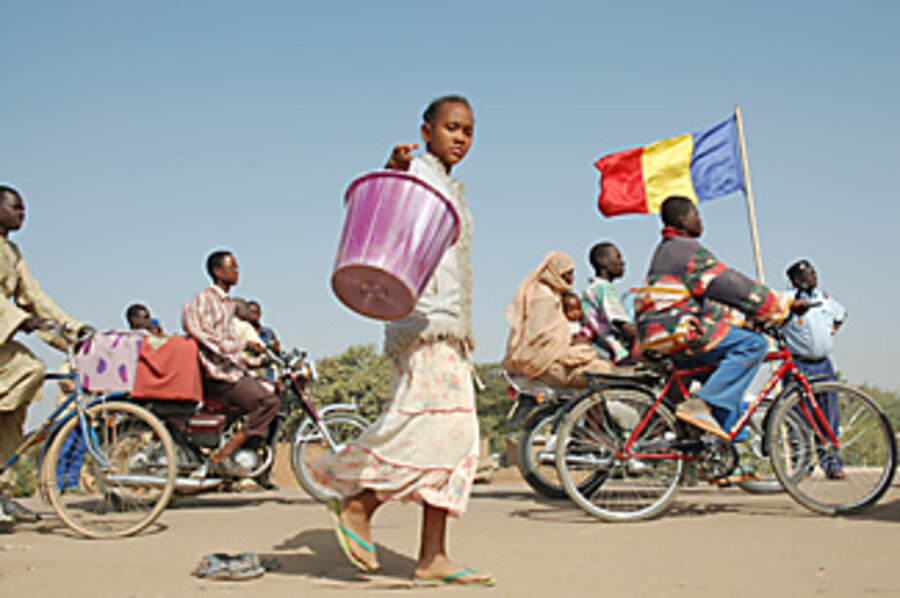
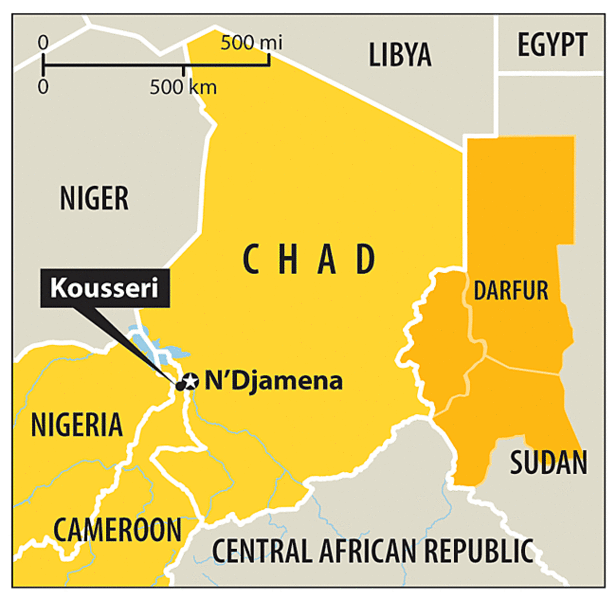
Carrying a tired child and a large plastic bag of possessions, Mallon Dgirhoulalimbay and his family are among the thousands walking home to Chad's capital, N'Djamena, after a rebel attack on the city earlier this month forced them to flee to neighboring Cameroon.
He's spent nearly a week in the Cameroonian border town of Kousseri, where he, his wife, and five children have squatted uncomfortably under a tree with their few belongings gathered about them. Though glad to be leaving Cameroon, he knows his troubles are not over.
"I'm going back, but I know it's not going to be easy," says Mr. Dgirhoulalimbay, as he begins the 15-mile walk to N'Djamena from the Cameroon border. "My house is OK, but I hear many things have been looted in town. And if the rebels come back, we'll be running to Cameroon again."
The attempted coup in Chad, which was repelled by government forces last week, has created yet another humanitarian emergency in a region already struggling to cope with hundreds of thousands of refugees. Existing aid operations that keep some half a million people alive in eastern Chad could be jeopardized, says the United Nations. Meanwhile, Chad has threatened to force 250,000 refugees from its territory after blaming them for worsening tensions with neighbor Sudan, which it says backed the rebels who launched the attempted coup.
At the peak of the exodus from N'Djamena last week, more than 30,000 Chadian refugees were officially registered in neighboring Cameroon, though more were absorbed by the local community, making accurate head counts difficult. The UN estimates that 20,000 refugees will remain in Cameroon in the medium term, needing food, water, and other basics. More Chadian refugees are being looked after by authorities 300 miles farther west, in Nigeria.
Many of those returning say they are heading back to Chad because they cannot cope with the poor conditions in Cameroon, where thousands of other refugees are sheltered in crumbling schools or sleeping outside.
Father of three Bouahima Razaki says that he and his family have had nothing to eat or drink for days. "Our children are getting ill from sleeping out in the night. It's better to go home; security or no security." A crowd gathered to listen in agrees with him in loud voices.
Maurizio Giuliano, of the UN's Office for the Coordination of Humanitarian Affairs in N'Djamena, says that distribution of food and water for up to 50,000 people began in Cameroon on Saturday.
"We would encourage refugees who feel it is safe enough to do so, to come back," says Mr. Giuliano. "Whatever aid they receive in Cameroon should not encourage them to stay."
The UN aims to provide the same services slowly being made available to refugees in Cameroon to the population of N'Djamena – both those who stayed throughout the fighting and those who are just returning. But that will not be easy.
Even though government forces, with military support from former colonial power France, repelled the rebels within two days, many public buildings were shot at, broken into, and partially burned down.
Hundreds died in the fighting and thousands were injured, according to the Red Cross.
In the aftermath, looting has been a major problem, including robberies of homes, businesses, and the stores of humanitarian organizations. Traders at the main market in N'Djamena either lost their wares to the fire that started when a government helicopter dropped a bomb meant for rebels, or saw what remained carted off by looters.
"Our town is broken, our market is broken. We have lost our brothers, our sisters, and our parents here, in these events," says office worker Ahmat Ahidjo, close to the market where smoke still rises from the burned-down stalls.
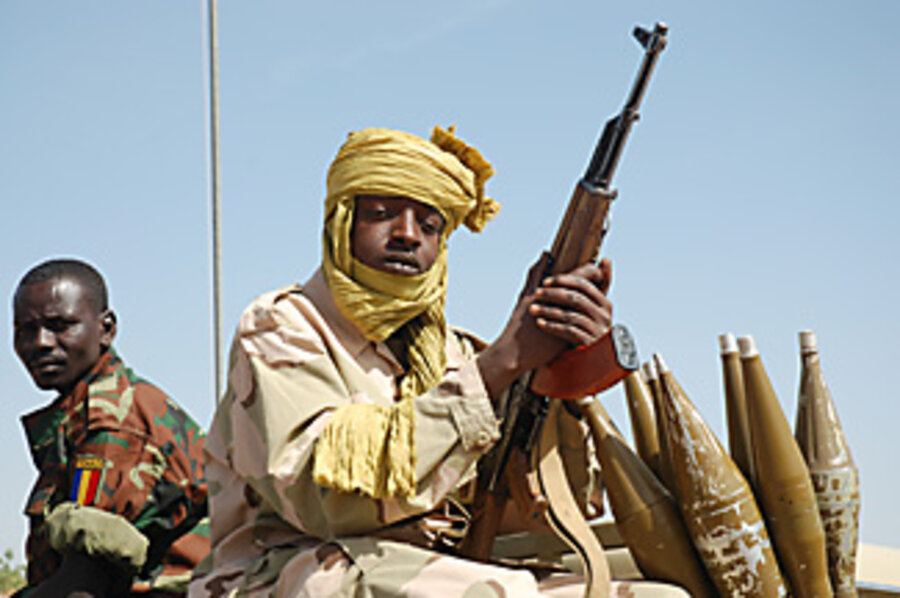
For now, a heavy presence of government forces wearing turbans and sunglasses against the harsh desert sun patrols the streets of N'Djamena providing a semblance of order that will take time to fully be restored.
Top UN officials have repeatedly voiced concern that the recent and ongoing instability in N'Djamena could jeopardize operations in the east of the country. There, some 250,000 refugees from the conflict in Sudan's Darfur region, and more than 100,000 Chadians displaced by the same conflict as well as some 50,000 refugees from the Central African Republic are reliant on international aid.
The European Union resumed deployment Tuesday of a much-awaited peacekeeping force to eastern Chad. The deployment had stalled because of the coup attempt, but Chad is blaming the refugees they are sheltering for the instability, further complicating the situation.
"We are being attacked by Sudan because of these refugees," Chad's Prime Minister Nouradin Koumakoye told reporters in N'Djamena on Monday.
"We demand that the international community transfer the population [of Sudanese refugees] from Chad to Sudan to free us," said Mr. Koumakoye. "We want the international community to look for another country so that the Sudanese can leave. If they cannot do it, we are going to do it."
This is not the first time that President Idriss Déby's government has said the Sudanese refugees are not welcome in Chad. Following a previous rebel attack in 2006, that Chad said had Sudanese backing, only intense international pressure forced Chad to back down and allow the refugees to stay.
Sudan has repeatedly denied that it backs Chadian rebels seeking to oust Mr. Déby.
But many Chadian refugees in Cameroon put their country's troubles firmly at the feet of their president for not entering into dialogue with the rebels, many of whom are related to the president or former members of his government.
Young men like Julian Ndoubanom, a student, say that Déby – who seized power in a 1990 coup – is so desperate to hold onto power that young men were being forced to fight against the rebels.
"Some of my friends were out playing football when we heard of the rebel approach," says Mr. Ndoubanom. "They were taken away, and I haven't seen them since."
Boris Behoudim also says he is frightened of being forced to fight for the government if he goes back to Chad. He says he's not going back until there's peace.
"For us to get peace in our country, maybe our president must leave or maybe he needs to get another solution to what the rebel groups are asking for. If not, we are not ready to get peace in our country," says Mr. Behoudim. "And I am not ready to go back to N'Djamena."
• For more on how Chad's refugees are surviving the turmoil, go to csmonitor.com.