
Putin to become United Russia chief, cementing hold on power
| Moscow
Vladimir Putin put the finishing touches to his postretirement formula for retaining power in Russia Tuesday by scooping up the leadership of the country's dominant political party, a position he will hold in addition to being prime minister.
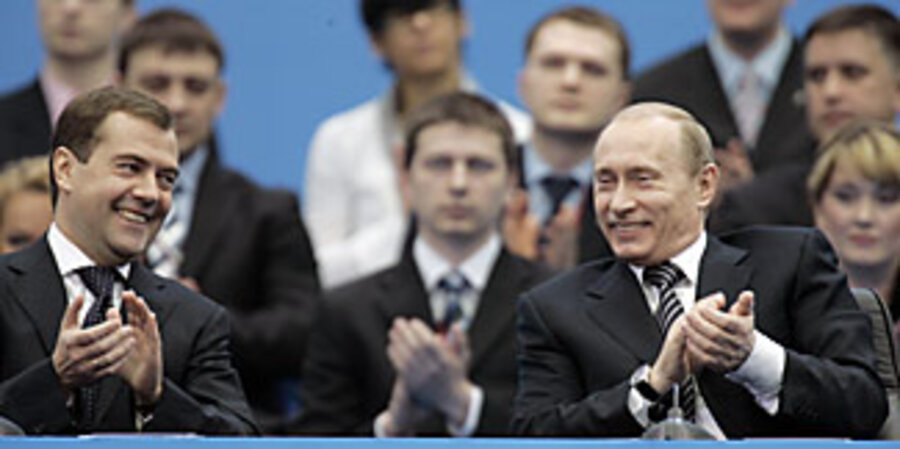
"I accept the invitation of the party. I am ready to take on myself the additional responsibility and head the party," Mr. Putin told delegates to the convention of the pro-Kremlin United Russia (UR) party, which controls 70 percent of the parliament's 450 seats. The 600 delegates, including many of Russia's top politicians, responded with a lengthy standing ovation.
Russian observers are deeply divided over the consequences of Putin's move, which will effectively leave Russia with two strong leaders after President-elect Dmitri Medvedev is inaugurated on May 7. Russia's historical experience with divided power has been an unhappy one, but many experts believe the close personal ties and complementary skills of Putin and Mr. Medvedev may produce a stable political synergy that will enable much-needed economic reforms and anticorruption measures.
Others warn, however, that any future strife between the two men, who represent very different generations and backgrounds, could split Russia's fractious bureaucracy and paralyze the work of government.
"This strengthens Putin's political weight as national leader," Sergei Markov, a United Russia Duma deputy, told journalists. "Dmitry Medvedev is leader of the state and of the Russian Federation, but the political leader of the country remains Putin."
'A new and dangerous situation'
Within a month, Putin will move from the Kremlin to Russia's White House, the gleaming eggshell-like building by the Moscow River that serves as the seat of government, to take up the job of prime minister. Under the country's Constitution, the prime minister is a presidential appointee, and the job has typically been filled by an unambitious technocrat. Although Putin's long-term aspirations remain an enigma, experts say he is not likely to settle easily into the role of second fiddle to the new Kremlin chief.
"This is a completely new and very dangerous situation for Russia," says Alexander Dugin, head of the nationalist Eurasia Movement. "We have two strong politicians, but all of the legitimacy lies with Putin. He has real charisma, huge popular support, his record of substantial achievements as president, and now the leadership of the main political party in the country. He will not be just another prime minister."
The new president, Medvedev, has no power base of his own and is entirely beholden to Putin's sponsorship for his ascent to the Kremlin. Yet Russia's president enjoys supreme powers under the Constitution, written by former President Boris Yeltsin after he crushed a defiant parliament with military force in 1993. Under Putin's eight-year leadership, the Kremlin greatly strengthened presidential powers by eliminating independently elected regional governors, subordinating the media, sidelining civil society groups, and ushering in a pro-Kremlin parliamentary majority.
"Everything Putin did while in power would seem to exclude the possibility of two power centers emerging now," says Yury Korgunyuk, an expert with the InDem Foundation, an independent Moscow think tank. "Putin is trying to cling to power by all possible means, but [under Russia's Constitution] everything will depend on the president's goodwill. Medvedev can easily fire the prime minister."
Medvedev and Putin have both publicly protested that problems will never arise between them. "[Putin] is an effective leader and he's ready and able to continue to work to advance the development of our country, to make sure our development continues in the way set out eight years ago," Medvedev said in an interview with the Financial Times last month. "I am confident that our tandem will prove to be absolutely effective."
But Putin's acquisition of United Russia's leadership, unexpected by many, may change that outlook. Putin was offered the party's chairmanship, a special post created by the convention on Monday that does not require him to actually join the party. At the convention, Putin was preceded to the rostrum by Medvedev, attending as a guest, who told the delegates it was a "logical" idea for Putin to take over the party's reins. That made Putin's acceptance look almost like an act of obedience to Medvedev's will.
"I am sure today's convention was played out according to a carefully written and rehearsed script," says Masha Lipman, an expert with the Carnegie Center in Moscow. "The main intent was to ensure that no tensions between Putin and Medvedev would be on display."
Though Putin is still not a member, the job now ties him formally to a party he was instrumental in creating, and whose candidate list he headed in last December's parliamentary elections.
"Putin is now the hostage of United Russia, which will try to work through him to create a party-dominated government in a country where the president is supposed to form the cabinet," says Alexei Mukhin, head of the independent Center for Political Information in Moscow. "United Russia was created to support Putin when he ran the Kremlin and it seems he will continue running the party as prime minister. But if Medvedev and Putin disagree, does that mean UR will become an opposition party? I foresee [bureaucratic] war."
'A window of opportunity'
Other experts point to the smooth stage management of politics under Putin to suggest the two men may continue to cooperate successfully.
"There is a window of opportunity here, now that Russia has two strong and popular leaders, to pursue major reforms," such as slashing the bureaucracy and curbing corruption, says Yaroslav Lissovolik, chief economist of Deutsche Bank in Russia. "They both have a great deal of experience and a lot of accumulated political capital. Now is the time to spend it."