

For Obama, bipartisan aims, party-line votes
| Washington
It was an unusual choice for a candidate seeking the Democratic presidential nomination. But in the first television ad of his campaign, Barack Obama let a Republican, a colleague from his days in the Illinois Senate, do most of the talking.
"Republican legislators respected Senator Obama," state Sen. Kirk Dillard, a John McCain supporter, said in a spot that aired in Iowa last June. "Senator Obama worked on some of the deepest issues we had, and he was successful in a bipartisan way."
GOP leaders in Illinois excoriated Mr. Dillard for the cameo, but Obama's message was clear: Though critics may accuse him of inexperience, bipartisanship – and a hawk's eye for common ground – is one area where his record matches his rhetoric.
A look at that record reveals a more complicated picture. As Obama moved from Chicago to the Illinois statehouse and then Capitol Hill, his early idealism became more pragmatic and calculating. While his message of unity has changed little – if anything, he has refined and enlarged it – his voting record in recent years has been decidedly partisan.
As a young community organizer on the South Side of Chicago in the mid-1980s, Obama taught poor residents how to press City Hall for cleaner neighborhoods, safer streets, and new jobs. As a state senator, he worked across the aisle to reform ethics laws and brokered deals between police and civil-liberties groups on measures to curb racial profiling and wrongful murder convictions.
But the record also shows more than a passing familiarity with old-school politics. He played hardball to win his first election, apprenticed himself to a scion of Chicago's Democratic machine, and voted "present" more than 100 times in the Illinois Senate in what critics have described as a dodge of controversial issues.
In the US Senate, he scored few bipartisan victories beyond a measure establishing a website for the public to track government spending. One nonpartisan study rated his voting record in 2007 as the Senate's most liberal, and Republican colleagues have accused him of putting politics before principle on ethics and immigration bills – charges his campaign denies.
"To judge from his voting, he's still pretty partisan," says Julian Zelizer, a congressional historian at Princeton University in New Jersey. In a polarized Senate, he says, "it's hard to be bipartisan. That said, that's the challenge he's going to face as president. If his record doesn't match what his promise is, can he achieve the promise, even if it's genuine?"
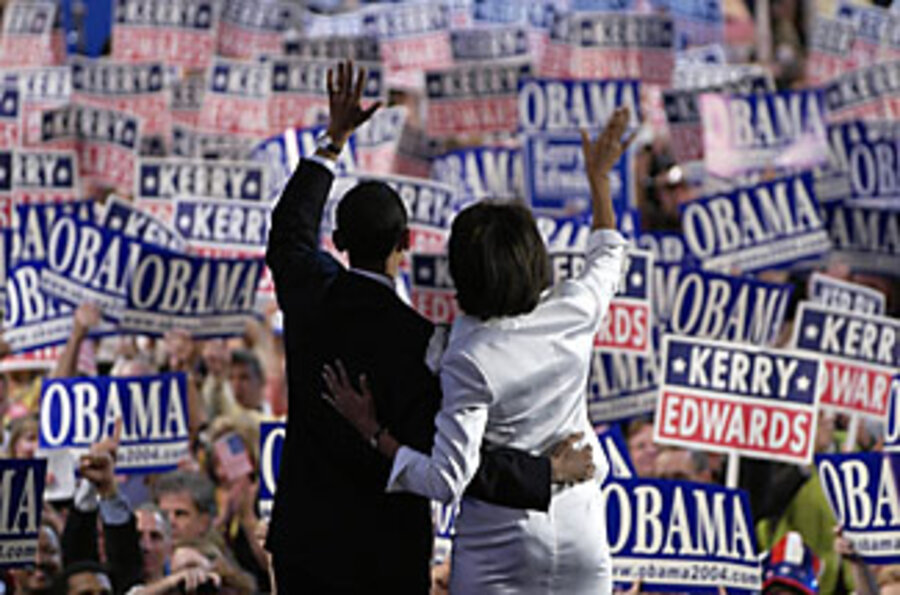
A plea for a "different kind of politics" has been a linchpin of Obama's message from the day he took the stage at the Democratic National Convention in 2004. "There is not a liberal America and a conservative America," he said in that star-making speech. "There is a United States of America."
But even as he moves closer to the Democratic nomination, surveys show that voters remain concerned about his experience. Obama has countered that while he may lack a conventional political résumé, he has "the right kind of experience," rooted in his multicultural upbringing, his grass-roots organizing, and a record of consensus-building.
"Occasionally, I would partner up with even my most conservative colleagues to work on a piece of legislation, and over a poker game or a beer we might conclude that we had more in common than we publicly cared to admit," Obama writes, in his 2006 book "The Audacity of Hope," of his days as a state senator. "Which perhaps explains why, through my years in Springfield, I had clung to the notion that politics could be different."
"If enough of us took that risk," he writes, "I thought, not only the country's politics but the country's policies would change for the better."
A review of his record reveals that Obama sometimes – but not always – took such a risk himself.
Early on, a collaborative approach
Twenty-three-year-old Obama arrived in Chicago in 1985 with no easy task: enlisting fiercely independent churches on the city's South Side to work together to improve neighborhoods ravaged by steel plant closings.
The nonprofit Developing Communities Project hired him in part because his life abroad and lack of local ties – to the African-American community, to churches – gave him a "sense of being an outsider," says Gerald Kellman, DCP director at the time. "It helped him identify with other people who might be outsiders, people who faced discrimination and poverty," he recalls.
Mr. Kellman had been schooled in the teachings of Saul Alinsky, a Chicago radical who preached confrontation and pressed organizers to appeal to authority figures' self-interest. But Obama believed in a more collaborative approach that borrowed from the civil rights movement and drew on long-nurtured relationships and a rhetoric of ideals, Kellman says.
When Obama learned that housing officials had removed asbestos from the manager's office but not the apartments at the Altgeld Gardens projects, he roused residents with an appeal to justice rather than a lecture on the health effects of toxins.
"If he came in and said, 'Your kids are affected by the environment,' he wouldn't have gotten anywhere," Kellman says. "So he framed the issue out of their own broader story of struggling against discrimination."
Another neighborhood cause was summer jobs, and Yvonne Lloyd, a mother of 11 who lived across from the projects, remembers that on a bus trip to the mayor's office Obama counseled civility. "He would say, 'You have to go in and be dignified,' " she recalls in a phone interview. " 'Don't raise your voice because you antagonize people that way.' " Before long, she says, a job intake center opened in the neighborhood.
Obama has called his three years on the South Side "the transformative experience of my career." "It allowed me," he wrote in an e-mail this month to campaign supporters, "to see that real change comes not from the top-down, but from the bottom-up, when ordinary people come together around a common purpose."
Even so, Kellman says, the DCP's accomplishments under Obama were limited. "Poverty remains. Structural unemployment remains. Bad schools remain," says Kellman, now a Catholic lay minister in Chicago. "We were able to whittle around the edges of it but not successfully change things."
Perhaps more lasting, he says, were the "individual success stories" of the local residents Obama worked with, many of whom gained the skills and self-confidence to find new jobs and move to better neighborhoods.
Obama left for Harvard Law School in 1988 on the belief that he needed to work at a higher level – as a lawyer, a public official – to bring about broader change.
But the decision was not straightforward. In his 1995 memoir "Dreams from My Father," he questions whether in leaving Chicago he was partly fleeing the reality of his own "inconsequence." "Maybe once you stripped away the rationalizations, it always came down to a simple matter of escape."
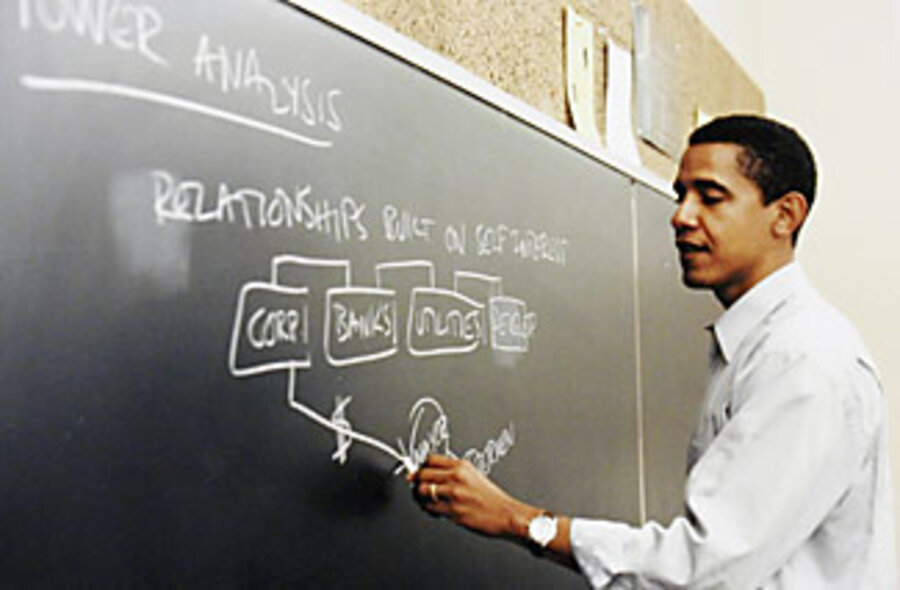
He returned to Chicago after law school and worked as a civil rights lawyer and university lecturer before running for state Senate in 1996. He pledged to bring his collaborative approach to Springfield.
But there was little evidence of collegiality in that first campaign. Alice Palmer, a state senator and fellow community organizer on the South Side, had decided to run for Congress and encouraged Obama to seek her seat. After Ms. Palmer lost, her supporters asked Obama to step aside so she could keep her Senate post. Not only did Obama refuse, but he challenged the signatures on her election petitions, driving her out of the race.
The idealist had learned that politics sometimes meant playing rough.
A record on civil rights
As a freshman Democrat in a Republican-led legislature, Obama sought as a mentor Senate minority leader Emil Jones Jr., a former Chicago sewer inspector and product of the Cook County political machine. Jones assigned Obama to a high-profile role in a bipartisan overhaul of Illinois's notoriously loose campaign-finance laws. It was unglamorous work that risked upsetting powerful lawmakers. The rules were so lax that some legislators had spent campaign funds on new cars, additions to their homes, and school tuition for their children.
Obama had wanted caps on campaign contributions but came to realize that would never pass, recalls Mike Lawrence, director of the Paul Simon Public Policy Institute at Southern Illinois University in Carbondale, which had worked with Obama, Senator Dillard, and two other lawmakers on the overhaul. Obama helped iron out a deal, approved in 1998, that barred the personal use of campaign funds, toughened disclosure laws, and banned many gifts from lobbyists.
"He impressed me as someone who had beliefs but also understood that when you're trying to get something done,... you have to be prepared to compromise," Mr. Lawrence recalls.
When Democrats took over the legislature in 2002, civil rights bills that had been bottled up for years gained new momentum. Obama sponsored a bill requiring law-enforcement officials in Illinois to record the race of motorists for a study of racial profiling. He also pushed through legislation requiring police to videotape interrogations of murder suspects.
The measures involved thorny legal issues and a delicate balancing of interests. But police and civil liberties groups – often at loggerheads – say they came away feeling their voices had been heard.
Laimutis Nargelenas, deputy director of the Illinois Association of Police Chiefs, recalls that other lawmakers had pressed for amendments that the police saw as unworkable, such as a requirement that videotaping begin the moment of arrest or that police officers ask motorists their race rather than guess.
Obama "was always willing to sit down and always wanted to hear, what were the unintended consequences," Mr. Nargelenas recalls. "Some other legislators would get a bill, put it through, and we'd say, 'Wow, these people don't have a clue how this would affect us.' "
Mary Dixon, legislative director for the ACLU of Illinois, a proponent of the bills, says Obama "helped law enforcement feel less attacked by the concept,… by repeating that, 'We know that the majority of law enforcement is doing a good job out there under difficult circumstances.' "
Still, Illinois Republicans say few of their number were as enthusiastic about him as Dillard, who appeared in the Obama ad.
"It is absolutely not typical," says GOP state Sen. Christine Radogno, who was elected the same year as Obama and is now the deputy minority leader. "I would challenge people to call every [Illinois] Republican who worked with Obama and find one other person that has that view."
The profiling and interrogation bills were an outgrowth of a broader effort, led by the governor, to reform the criminal-justice system in the wake of wrongful death-row convictions, she says. And while Obama has defended his "present" votes as a common practice to protest flawed bills, Senator Radogno says he overused them, sometimes as political cover on contentious issues. "If a bill has a fatal flaw," she says, "you ought to vote no and explain it."
Other lawmakers saw Obama as ambitious and aloof. "Everybody wasn't thrilled about Mr. Goody Two-shoes coming in here and imposing all his great ideas on how we need change, when nobody was begging for it," recalls Paul Williams, a lobbyist and former Democratic state representative who supports Obama. "A few people had got their Barack dartboards, and were saying, 'Where does this freshman get off?' "
Bipartisan ideals tested in US Senate
Obama was elected to the US Senate in 2004, a challenging year for a promoter of cross-party bonhomie. Democrats had lost another close election for the White House, Republicans had widened their Senate majority, and Americans were bitterly divided after a bruising campaign season. Moreover, the Senate hierarchy affords freshmen – even those with Obama's celebrity – little power.
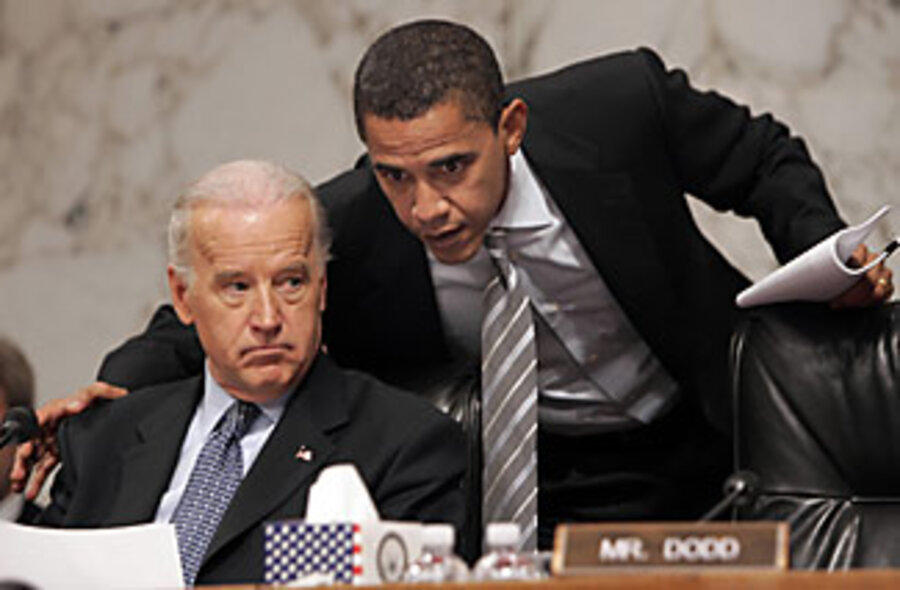
Obama's most significant bipartisan achievement there is a new online database for the public to look up federal contracts and other spending. Obama sponsored the 2006 measure with Oklahoma Republican Tom Coburn, one of the Senate's most conservative members, amid reports of questionable contracts in the wake of hurricane Katrina.
Obama also cosponsored a bill with Sen. Richard Lugar, an Indiana Republican, that expands the State Department's ability to detect and destroy weapons of mass destruction.
Other efforts didn't go as smoothly. During negotiations over lobbying and ethics reform in early 2006, Senator McCain sent Obama a blistering letter accusing him of "self-interested partisan posturing" for backing a plan that McCain saw as damaging to bipartisan negotiations. Obama sent McCain a letter denying the charge and told reporters that McCain was being "cranky."
Tempers soon cooled. But the two did not see eye to eye on the final reform package, which was overseen in the Senate by Obama and another Democrat, Russ Feingold. The measure became law without the support of McCain, a longtime leader on ethics and campaign-finance reform, who said it did not go far enough to curb pork-barrel spending.
Obama was part of the bipartisan group of senators who began meeting in 2005 on comprehensive immigration reform. But last summer, with the presidential nominating race well under way, Obama backed 11th-hour amendments – supported by labor, immigrant rights, and clergy groups – that Republicans saw as imperiling the fragile compromise.
None of those measures passed. But Obama was part of a 49-to-48 majority that voted to end after five years a temporary worker program that had been a cornerstone of the immigration deal. The vote, backed by labor, was seen as a major setback to bipartisan negotiations.
"That's great to talk about bipartisanship and change, but to bring us together on big issues, you've got to say no to your base," says Sen. Lindsey Graham (R) of South Carolina, whose approval ratings in his home state plummeted during the debate.
"Bipartisanship that really matters on something big comes at a price," says Senator Graham, a prominent McCain supporter. "I was disappointed" in Obama.
Obama aides say he voted to sunset the proposed program because it lacked adequate wage protections for temporary workers. The comprehensive reform effort died after Obama and other senators tried – but failed – to put it to a floor vote.
Obama aides dispute his rating by the nonpartisan National Journal as the Senate's most liberal senator in 2007. They note that he was campaigning and missed a third of the 99 votes on which the magazine based its tally. "Obama has spent his career in public service uniting Americans of different ideologies and from different backgrounds to take on our common challenges," Ben LaBolt, a campaign spokesman, writes in an e-mail.
Still, the magazine's ratings from earlier years show Obama drifting left. It ranked him the 16th most liberal senator in 2005 and the 10th most in 2006. Sen. Hillary Rodham Clinton was rated 20th most liberal in 2005 and 32nd in 2006.
In the end, analysts say, a short stay in the Senate may be a blessing for a proponent of post-partisan unity.
"The longer you stay in the Senate – the more votes you take, the more fights you get into – the harder it is to expand your base," says Donald Ritchie, the Senate's associate historian. "The more you have cases where you tried a coalition and it didn't work, or you backed out of a bill because you ... had problems with constituencies back home, the more ammo the other side has against you."