

The rising impact of high oil prices
| New York
Americans cannot avoid the soaring price of oil.
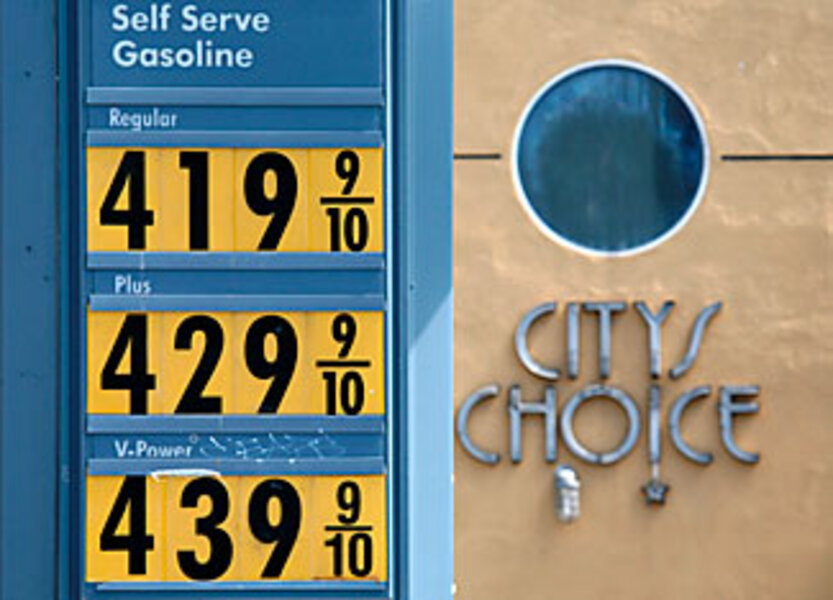
They pay for it at the pump, with gasoline at a record $3.42 a gallon. They get hit by fuel surcharges when they book airline flights. Higher fuel prices are a major reason for rocketing food prices – in part, because corn is being diverted from the food supply to make ethanol, in part because of higher fuel costs to produce and transport food.
Now, rising energy prices – oil hit records above $115 a barrel this week – are causing concern about the potential damage to the economy. Americans are spending a larger share of their income on energy than at any time since 1986. That has crimped pocketbooks and helped dampen consumer sentiment. Purchases of everything from cars to clothing are falling.
"We are all worth less and earning less than a year ago," says economist Mark Zandi of Moody's Economy.com. "That is why consumers are pulling back, and judging from the confidence numbers they are in a panic mode."
Many energy analysts believe the bad news is just beginning – the price of gasoline is expected to continue rising through Memorial Day.
Since the beginning of April, the price of gasoline has risen by 13 cents per gallon, according to AAA, a drivers' organization in Heathrow, Fla. AAA is predicting gasoline prices on a national basis will hit $3.50 a gallon by Memorial Day. "It's well within the range of possibilities, but we think $4 a gallon is still premature," says Geoff Sundstrom, a spokesman.
One indicator of the effect of the steady rise in oil prices came on Wednesday when the Labor Department reported that the March consumer price index, a measure of the rate of inflation, rose by 0.3 percent – or close to a 4 percent annual rate after no change in February. Energy prices alone rose 1.9 percent in March, with gasoline climbing 1.3 percent.
If it were not for a large drop in clothing prices – due to retailers trying to unload inventory – the overall inflation rise would have been much higher. If you didn't eat and didn't drive, the inflation rate was only 0.2 percent, barely within the Federal Reserve's comfort level.
In the past three months, average consumer spending on energy came to $663 billion, or 6.5 percent of total consumer spending, according to Moody's Economy.com. A year ago, it represented 5.8 percent and in 2002, it was 4.1 percent of their spending. "If gasoline breaks through $4 a gallon by Memorial Day, that would mean spending on gasoline would have risen by $100 billion since the beginning of the year, or roughly the size of the tax rebate checks going out," says Mr. Zandi. "The rebate checks are going to pay for filling up our tank."
Energy prices, particularly at the pump, are now part of the presidential campaign. On Tuesday, Sen. John McCain (R) of Arizona, as part of a broad economic plan, proposed removing the federal tax on fuels, 18.4 cents a gallon for gasoline and 24.4 cents on diesel from Memorial Day to Labor Day.
"The effect will be an immediate economic stimulus – taking a few dollars off the price of a tank of gas every time a family, a farmer, or trucker stops to fill up," said Senator McCain said in his speech at Carnegie Mellon University in Pittsburgh.
Opponents of the proposal quickly pointed out that the tax goes to fund highway and transit programs. Without the tax, the government would lose $9 billion in revenue. "We have looked at it in terms of jobs and estimate 312,000 jobs would be in jeopardy, so it's a little puzzling for us why you would do something to depress a major sector of the economy – construction," says Matt Jeanneret, a spokesman for the American Road & Transportation Builders Association in Washington.
The construction industry is also feeling the pinch of rising energy prices, says Ken Simonson, chief economist for the Associated General Contractors of America in Arlington, Va. "It's brutal," he says. "Contractors use a great deal of fuel ... for digging equipment and moving earth and now they are paying whopping fuel surcharges."
On Tuesday, a government report showed how energy prices are eating into the corporate bottom line. The March producer price index (PPI), a measure of changes in wholesale prices, rose 1.1 percent over the prior month. So far this year, the PPI is up 6.9 percent.
"This is really going very badly for retailers," says Scott Krugman of the National Retail Federation in Washington. "Basically, the high gasoline prices are like an extra tax on the industry."
Mr. Krugman says the federation's past studies have found consumers react to rising gasoline prices by making small sacrifices. "We have found the first way they cut back is by eating out less," he says.
That would be the case for Nancy Owens in Rochester, N.Y. This winter she cut off her cable TV to pay for heat.
Ms. Owens, a former hospital worker now on disability, only goes to restaurants for special occasions. "It really cuts off your social life," she says, "but right now, I only use the car for groceries and doctors' appointments."