

Potent greenhouse-gas methane has been rising
After nearly a decade of holding relatively steady, levels of methane in the atmosphere appear to be rising, and scientists are trying to find out why.
The uptick is tiny, especially compared with the growth in carbon-dioxide emissions from industrial activity and land-use changes. But the shift has still raised eyebrows.
Pound for pound, methane is 25 times more effective as a greenhouse gas than carbon dioxide. So powerful is its effect that some experts have proposed that the world could meet climate targets more readily if it made big strides in reducing methane and other greenhouse gases that are less abundant but more potent.
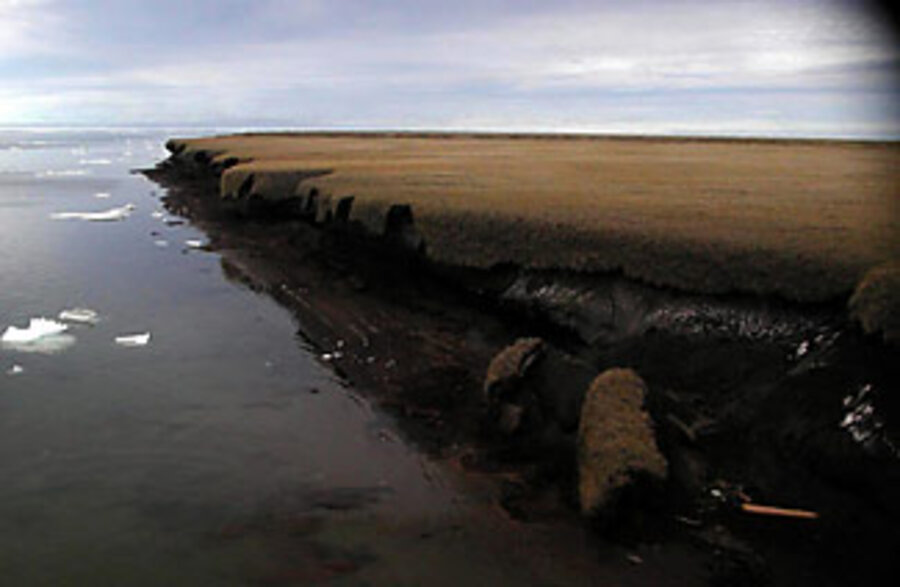
If the increase seen last year continues unabated, researchers worry that over the long term, it could help bring on significant additional warming. As Earth's climate warms, it could trigger a steady release of methane as permafrost in the Northern Hemisphere's high latitudes thaws and the organic material it kept on ice begins todecompose. The more methane the permafrost loses, the more the climate warms.
The increase "comes on top of a period where methane barely increased at all," says Ed Dlugokencky, a researcher at the National Oceanic and Atmospheric Administration's Earth Systems Research Laboratory in Boulder, Colo. "I think that's why it looks so remarkable."
During the early 1980s, he says, methane levels in the atmosphere rose at an average annual rate of 14 molecules for every billion molecules of other gases, although the growth rate was beginning to slow over that period. From 1999 to 2006, methane's abundance in the atmosphere was relatively constant.
Last year, however, the concentration rose by 10 parts per billion to an overall level of 1.8 parts per million (p.p.m).
When its direct and indirect effects on the atmosphere are considered, its current warming effect is about half that of CO2, even though it is far less abundant. Both gases are substantially more abundant now than at any time during the last 650,000 years, according to research summarized by the Intergovernmental Panel on Climate Change last year.
Last year's methane rise may stem from wetlands' emissions at high latitudes in the northern hemisphere, Dr. Dlugokencky speculates. He notes that 2007 was a particularly warm year there. "We're pretty sure it didn't come from biomass burning" because the data doesn't show a big increase in carbon monoxide, another byproduct of burning biomass.
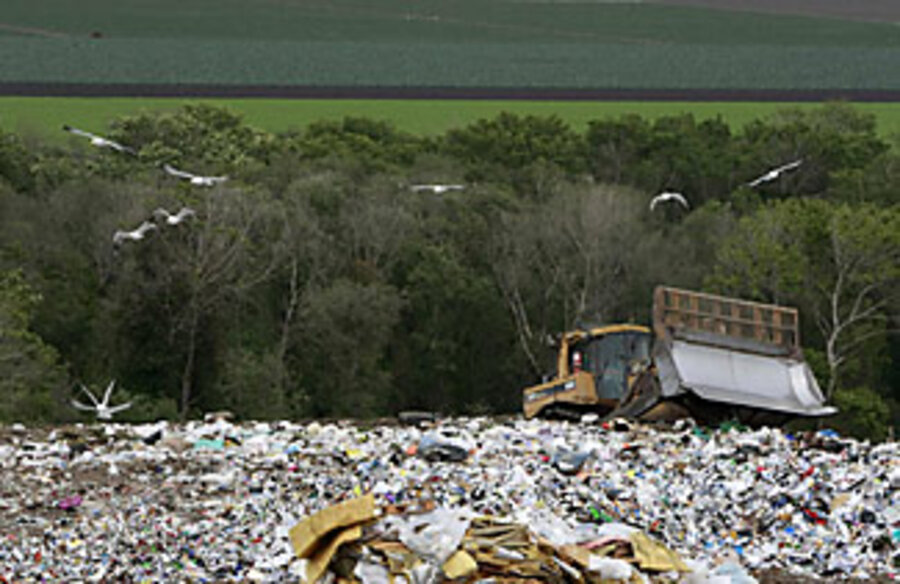
Methane rises from natural sources such as wetlands – as submerged plant material decays – wildfires, permafrost, and ocean sources. But estimates put human-related emissions – from farming to landfills – at some 60 percent of the methane in the air.
Factoring methane
One of a handful of gases that appear in tiny amounts but are far more potent warming agents than CO2, methane's climate significance – along with other trace gases and black carbon soot – have led some researchers to suggest that clamping down quickly on these emissions could buy some time to deal with the thornier problem of reducing CO2 emissions.
Countries are currently negotiating a new climate agreement to take effect after 2012. Several key players, including the European Union, argue that to avoid dangerous climate change, the world must hold the increase in global average temperatures to between 3.6 and 5.4 degrees Fahrenheit by 2100. That means stabilizing CO2 concentrations at about 450 p.p.m.
Recently, however, a team led by James Hansen at the National Aeronautics and Space Administration's Goddard Institute for Space Studies in New York have begun to argue that the CO2 target must be 350 p.p.m. or less to account for additional, long-term amplifying effects of warming.
Without seriously tackling methane and these other sources of warming, "our CO2 requirements could be ... tougher than the 350 target," Dr. Hansen says. Making serious reductions in methane, tropospheric ozone (to which methane contributes), and black soot, he continues, could ease the requirements on CO2 by some 25 p.p.m.
More research needed
At least for several developed countries, much of that low-hanging fruit may already have been picked, according to Michael Prather, an atmospheric chemist at the University of California at Irvine and a lead author on last year's IPCC reports. The flat trends in methane over the past eight years defied previous IPCC projections.
The reasons, he says, could range from changes in energy demand in Russia after the fall of the Soviet Union to a push by industry in the US and Europe to tackle methane from leaky pipelines, landfills, and other sources as their first cut at controlling greenhouse gases.
The uptick NOAA detected "is a surprise," he says. "But in some sense it could mean that we're just back to normal."
The task now, Dlugokencky and others say, is to conduct detailed analyses of last year's methane samples to try to identify the sources – Northern Hemisphere versus Southern and natural versus human generated.
In addition, some researchers are calling for many more sampling sites. This, they say, would allow monitoring of emission-control efforts in various regions and figuring out whether critical feedback mechanisms, such as thawing permafrost, are finally their heat-trapping inventory to the atmosphere.