

Arizona's solar aspirations in peril
| Phoenix
The sun shines 325 days a year in Arizona, on average, and some here see that as the state's biggest energy asset.
But fledgling efforts to turn Arizona into the solar capital of the world depend on making the initial investment in new energy plants affordable – something that could become much more difficult, perhaps even impossible, if a federal tax credit for solar projects expires at the end of the year as scheduled.
Arizona is by no means the leader in developing renewable energies, but it has made progress. The latest achievement is at the Phoenix Convention Center, where workers are nearly finished installing 732 peel-and-stick photovoltaic solar panels on the two-acre roof of the center's West Building. The $850,000 project is the largest solar application in downtown Phoenix and is expected to generate 150 kilowatts of power yearly.
"We have a tremendous solar energy resource, up to seven or eight solar productive hours a day," says Ardeth Barnhart, associate director of the Arizona Research Institute for Solar Energy (AzRISE) at the University of Arizona in Tucson. "Other states like New Jersey have very progressive policies, but we've got more sun. We could theoretically power the US with a very large stretch of land – about 100 square miles – in Arizona."
But plans for a project that could put Arizona on the map as a solar powerhouse – a huge $1 billion solar energy plant to be built near Gila Bend, Ariz., by 2011 – are likely to be scrapped if the tax credit is allowed to lapse. That's because solar power is still more expensive to produce than is electricity derived from fossil fuel, though some experts expect the gap to close in the next seven to 10 years.
The subsidy in question is the federal Investment Tax Credit. The US government boosted the ITC from 10 percent to 30 percent for solar systems in 2006, meaning that 30 percent of the cost of building and installing a system is returned to the investor in the form of a tax credit. But that rate is set to expire at the end of 2008. That scenario worries many political, business, and academic leaders here, who see their dreams of a solar-energy hub evaporating.
"The extension of the tax credit is critical," says US Rep. Gabrielle Giffords (D) of Arizona in a phone interview. "I've introduced legislation to extend it to 2016."
Representative Giffords is urging that the government pay for the extension by reducing tax credits to oil and gas companies. During "the next five years, [oil and gas companies] are slated to receive about $17 billion. That money instead should be going toward renewable energy," she says. "It is critical, and I believe Democrats and Republicans acknowledge it."
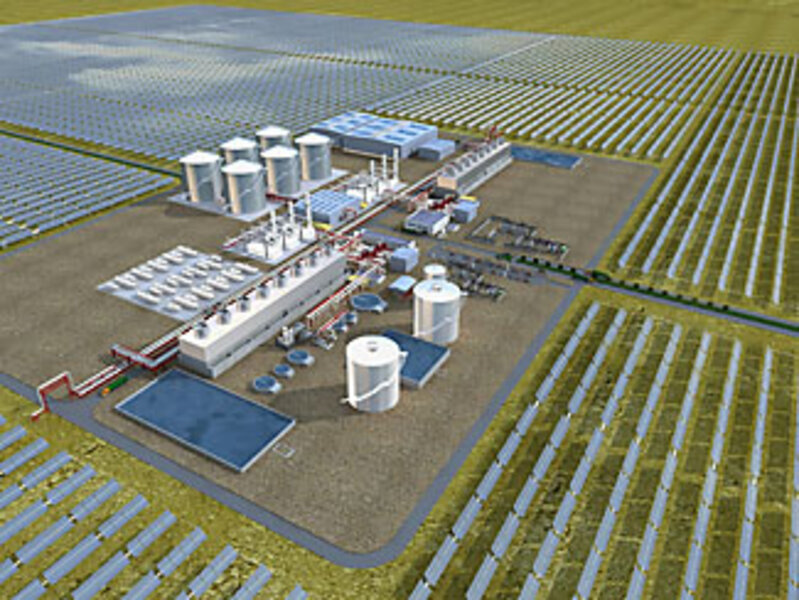
The Arizona Public Service Co., the utility that is the driving force behind plans for the Gila Bend solar plant, already owns smaller solar plants. This yet-to-be-built one, called Solana (Spanish for "sunny place"), would cover three square miles with trough mirrors and receiver pipes and would include two 140-megawatt steam generators. It would provide enough energy to power 70,000 Arizona homes, according to Barbara Lockwood, an APS official.
Arizona law now requires utilities to invest in renewable energy. Currently, 90 percent of the state's electricity is produced by natural gas and coal.
"They have to generate 15 percent of electricity from renewable-energy sources by 2025," says Govindasamy TamizhMani, director of the photovoltaic testing lab at Arizona State University. "So all the utility companies are trying to meet that mandate."
Giffords, who ran for Congress in 2006 on a platform of pursuing solar energy, recently led a group of lawmakers and experts from Arizona on a fact-finding trip to Nellis Air Force Base in Nevada, home of North America's largest operational solar photovoltaic system. The $100 million, 14-megawatt plant is an example of what might be done at Davis-Monthan Air Force Base near Tucson, says the freshman lawmaker.
"What's so exciting about solar energy is that it creates an elegant solution to three of the largest challenges that ... face our country today," says Giffords. The first, she says, is US dependence on foreign energy. The second is global warming, and the third is advances in technology.
Those advances in technology, she argues, could help America lead the world in this field.
"I'm very concerned that America is falling behind. Pursuing solar energy, cleaner-burning energy, renewable energy can absolutely lead to economic prosperity," says Gifford.
Many in the solar energy field say the rising price of oil, and the possibility of a future tax on carbon emissions, is likely to make the solar option more competitive – and soon.
"People are looking at some kind of cost parity, some comparable costs in the next seven to 10 years," says Ms. Barnhart of AzRISE.
ASU's Dr. TamizhMani agrees. "At the moment, the industry depends on incentive money, but by 2015 the cost of conventional electricity and solar are expected to be equal."