

Turkey aims for clout as regional mediator
| ISTANBUL, TURKEY
Drawing on its close ties with Israel and growing closeness to Syria, Turkey is working to position itself as a key regional mediator in the Middle East.
Last week, Israel and Syria revealed that Ankara had stepped in to fill a diplomatic vacuum by facilitating back-channel discussions between the two states.
That effort received a boost Sunday from Secretary of State Condoleezza Rice, who said that the United States would back such a peace initiative. She qualified her support by stating that Damascus needed to rethink its policy toward Lebanon.
Turkey's bid, analysts say, is part of a larger plan to improve its relations with neighbors and take full advantage of its location and historical Ottoman ties to play a larger role than it has in previous decades. But many questions remain about its ability to establish itself as a heavyweight quite yet.
"Turkey has become one of the pollinators, one of the actors on the circuit. It's hard to think of anyone else who can visit the wide variety of countries, from Israel to Iran, that Turkey can," says Hugh Pope, Turkey analyst for the International Crisis Group, a Brussels-based policy and advocacy organization. "I don't think there are many diplomats visiting Tehran who have just visited Israel, and that's a valuable role."
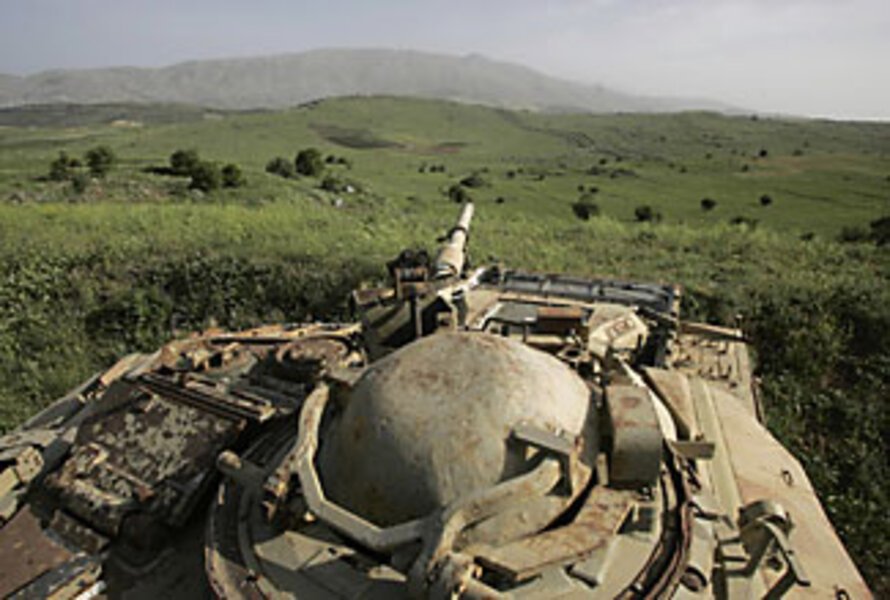
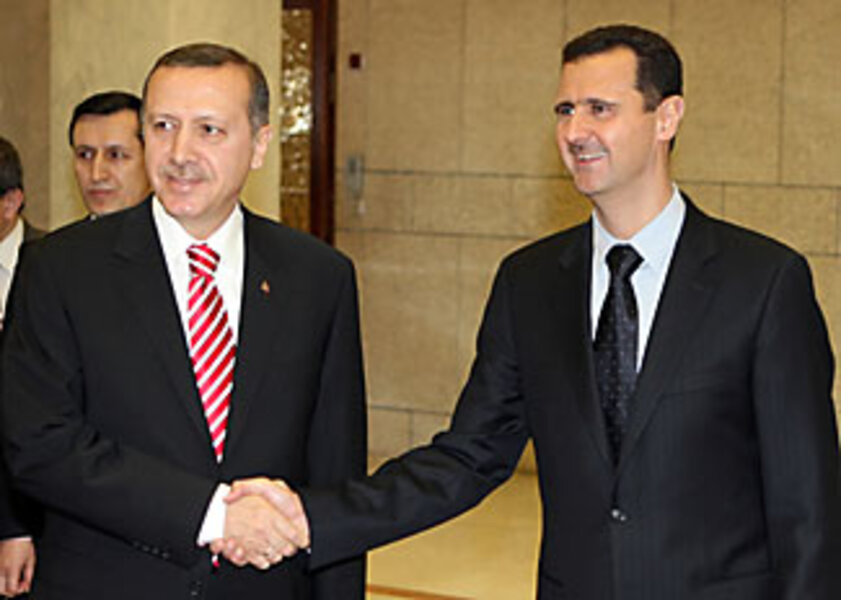
In an April interview with Qatar's al-Watan newspaper, Syrian President Bashar Assad said an Israeli offer to withdraw from the Golan Heights in return for permanent peace was delivered to him through Turkish Prime Minister Recep Tayyip Erdogan. Israeli officials have confirmed Ankara's role in reaching out to President Assad.
"To a certain extent, [the Turks] have succeeded in increasing their visibility and importance in the region, and people have responded to that. They have achieved something," says Henri Barkey, an expert on Turkey at Pennsylvania's Lehigh University.
Facilitating between Syria and Israel "gives you an idea of how much the [Turkish government] wants to be a player in the region," he adds. "They do see themselves as a major part of the region. That is a big shift from previous governments, which wouldn't have bothered with this."
Long-time enemies Israel and Syria have not negotiated directly since US-brokered talks collapsed in 2000. Since then, US-Syrian relations have deteriorated steadily. Meanwhile, Ankara and Damascus have been improving their previously strained relationship.
Burak Ozugergin, a Turkish Foreign Ministry spokesman, says Turkey can facilitate contact because of its close ties to both sides. "Things are progressing and Turkey will continue to be available as long as both sides want it," he says. "We have not interjected ourselves into the mix. Both sides were willing to go through Turkey."
Alon Liel, a former director general of the Israeli Foreign Ministry who has conducted unofficial talks on an Israel-Syrian peace, said that Turkey first offered to serve as a go-between in early 2004. Then-Prime Minister Ariel Sharon turned Ankara down. Three years later, Israeli Prime Minister Ehud Olmert, fearing talks with the Palestinians might fail, took Turkey up on its offer.
"There is an interest on Israel's part in keeping the peace momentum," Mr. Liel says. "If you cannot move on the West Bank, everybody is looking up to the Golan Heights and looking to see what can be up there."
Turkey had been criticized by some US officials for improving relations with Syria as the US was trying to isolate Damascus for its ties to Iran and Hizbullah.
Turkish officials have refused to give details about any future contacts between Syria and Israel, but Israeli press reports have suggested that Ankara might broker meetings between low-level officials.
Secretary Rice said last Friday that Washington had confidence in at least two of the participants in the process.
"In terms of the reports of Turkish mediation between Syria and Israel, we have confidence in Turkey, we have confidence in Israel," Rice told reporters en route to a London meeting. "I think it's quite clear that we don't have much confidence in Syria."
Most observers, while lauding Turkey's efforts, say that the country doesn't yet have the diplomatic expertise or weight to bring about a comprehensive settlement on its own. Rather, it represents another track, one that could help move any dialogue further along. The Erdogan government is also facing the possibility of being closed down by Turkey's top court, something that could further undercut Ankara's ability to sustain its new efforts.
"Obviously, Turkey is not the United States in this game," says Suat Kiniklioglu, a member of the governing Justice and Development Party (AKP) and spokesman of the parliament's foreign affairs committee.
"But our plan is to facilitate any contact or dialogue that will, hopefully, lead to a deal," he adds. "The prime minister doesn't think this is a waste of his time or energy. The thinking in Ankara is that the status quo in the Middle East is not sustainable, and we want to prevent whatever damage we can."
• Josh Mitnick contributed to this report from Tel Aviv.