

For China's Olympic guests, a not-so-warm welcome
| Beijing
"Beijing Welcomes the World."
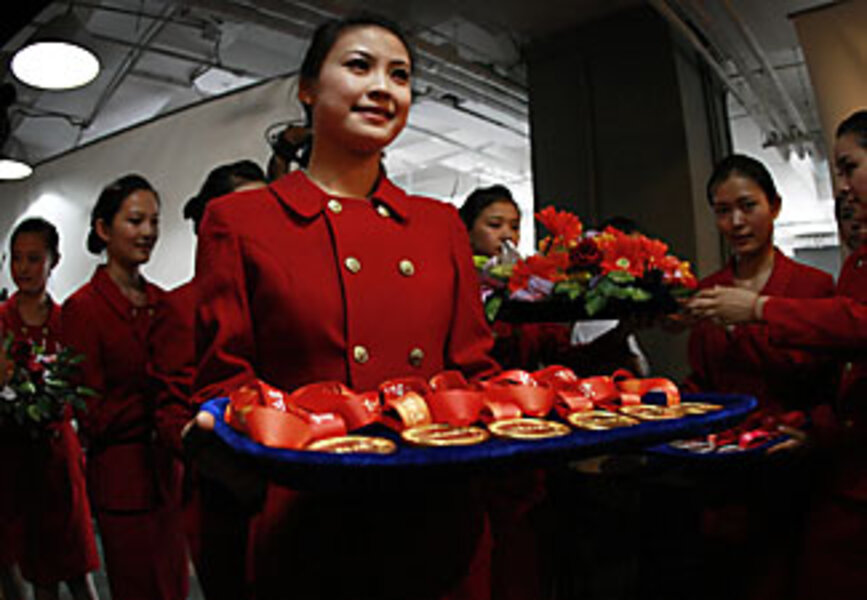
That slogan is everywhere nowadays in the Chinese capital. But as the Games draw near, the eight-tooth smile that Olympic hostesses have been taught is beginning to look a little strained.
Fearful of terrorist attacks and of embarrassing protests, the authorities are draping a security blanket over Beijing so thick that many residents fear it will stifle the Games.
"They are not taking any chances, whatever the impact on ordinary people, either local or foreign," says Gilbert van Kerckhove, a longtime Beijing resident who is advising the city on Olympic issues. "They are totally paranoid; there is no other word for it."
In preparation for the Olympics, long billed as China's coming-out party, the government has tightened visa rules to restrict the number of incoming foreigners, snarled international broadcasters' plans to televise the Games, cleared almost all Beijing's itinerant vendors off the streets, and closed down one of the city's most popular English-language magazines, among other steps apparently designed to ensure control of the event.
The gathering mood here has caught the attention of the International Olympic Committee (IOC), which organizes the games.
"We have asked the Chinese to try to find the right balance between security and operations, and I have confidence that they will do so," said the IOC president, Jacques Rogge, earlier this month.
'More serious' visa regulations
Attracting the most attention among Beijing's 250,000 foreign residents are the "more strict and more serious" visa regulations that a foreign ministry spokesman explained recently are aimed at ensuring Olympic security.
They have made it much harder for foreigners to get into China and to stay here once they have arrived.
The effects of rules introduced last month – eliminating multiple-entry visas, requiring applicants for visa renewals to return to their home country, and demanding proof of professional qualifications – have been felt most acutely among the hordes of young people who have been attracted to Beijing as an internationally fashionable place to live and who either study here or make a living as best they can.
Likely participants in the sort of protests the government is anxious to curb, they are not the sort of people the authorities want in Beijing in August. But the rules have also hampered international businessmen, prompting official complaints from foreign chambers of commerce.
"Business opportunities are being missed," the European Chamber of Commerce warned the Chinese government in a letter, since the rules "impose dramatic costs in terms of both time and money."
"Many European companies from multinationals to small- to medium-sized are experiencing issues with obtaining business visas," says the chamber's secretary general, Michael O'Sullivan, "and we have not noted any further changes in the situation" since the letter was sent.
Television broadcasters, meanwhile, are still battling the Chinese security bureaucracy six weeks before the Games' opening ceremony, seeking assurances they will be able to broadcast live from such iconic locations as Tiananmen Square and elsewhere.
It is still unclear, they say, whether Beijing will give way. "Unless the authorities relax and are a little more free with the media, they may well compromise coverage of the games," warns John Barton, director of sports at the Asian Broadcasting Union.
Ordinary Beijingers are more affected by minor irritants: new restrictions on what they can send in the mail (no electronics, no powder, no soap), a ban on the sale of fireworks, plans for airport-style security on the subway during the Games, and the disappearance of street vendors selling snacks and other items, most of whom come from out of town.
"The city police drove them all out," says one fruit-seller who has so far evaded arrest of his erstwhile competitors on a street near the Foreign Studies University. "It's because of the Olympics. They've all gone home ... and they can't come back until after the Oct. 1 holiday."
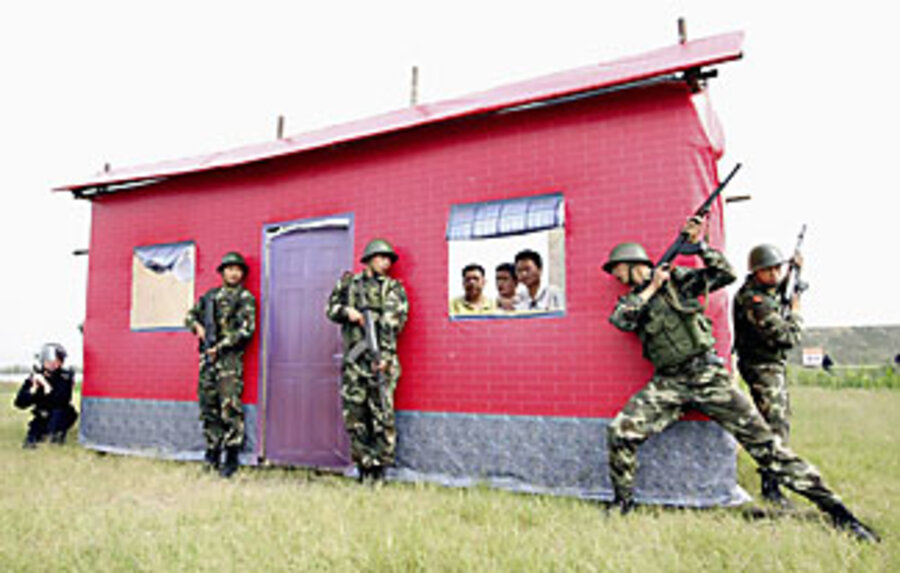
Such moves appear designed to reduce the workload for the 100,000 security agents – policemen, militarized police, security guards, and volunteers – that the city says it will mobilize for the Games. At the same time, 300 specialists in nuclear, biological, and chemical attacks will be on alert starting July 1, officials say, along with 100,000 commandos and ordinary soldiers in reserve.
A terrorist attack tops the authorities' list of security concerns, according to the police. They are especially concerned by the threat they see from militants demanding independence for the western province of Xinjiang, largely populated by the Muslim Uighur people. Earlier this year, the police announced they had foiled a plot by Uighur separatists to blow up a plane flying from the Xinjiang capital of Urumqi to Beijing.
Large gatherings canceled
But the government also appears nervous about large gatherings of foreigners. Last month the government banned a pop-music festival that traditionally attracts foreign bands and large numbers of foreign residents. It also canceled a conference of the Holland-based Institute of Anthropological and Ethnological Sciences for which 6,500 international academics had registered.
"What has happened around the torch has resulted in a stepping-up of the whole security issue, and security weighs heavily on all the decisionmaking now," said Hein Verbruggen, the IOC official in charge of overseeing preparations for the Olympics, recently.
The result, fears Mr. van Kerckhove, will be that Beijing "will be a police city. There will be no mood ... because everything will be controlled."
The controls extend to even the smallest detail. Chinese sports fans have been provided an official cheer, designed by the ruling Communist Party's Office of Spiritual Civilization Development and Guidance, involving raised thumbs, clapping, fist punching, and the chant "Go Olympics, go China."
Foreign visitors will be permitted to choose their own cheers, but they will have to abide by the rules published recently on the website of the Beijing Organizing Committee of the Olympic Games. These include a warning that "any illegal gatherings, parades, and protests and refusal to comply are subject to administrative punishment or criminal prosecution."
The guide also lists materials that may not be brought into China, such as items "that are harmful to China's politics, economics, culture, and morals."
It is still not clear just how many foreigners will attend the Games. Officials have said they expect half a million visitors from abroad, but difficulty in obtaining visas and tickets to Olympic events could reduce that number.
Only 25 percent of tickets to this year's games were allocated to international sales – half the proportion that organizers of the Athens Olympics sold abroad in 2004. Organizers point out that China is the most populous nation to host the Games, but their decision has made it harder for foreigners to buy tickets.
That may explain disappointingly slow bookings for hotels at a time when Beijing was meant to be bursting with visitors. Although the city's five-star hotels, where Olympic and national officials will stay, are registering a 77 percent occupancy during the Games, four-star hotels have so far filled only 44 percent of their rooms, according to Zhang Huiguang, director of the Beijing Tourism Bureau.
The figure "is even lower for three- and two-star hotels," she told reporters recently.
[Editor's note: The original slideshow may have implied that two photos taken in Nepal were from Tibet.]