

A 'surge' unit sees change, but questions its permanence
| Baghdad
After almost 15 months of its longest, deadliest, and most unconventional deployment, the 1st Battalion, 64th Armor Regiment of the US Army is packing up to leave Iraq.
When it goes home to Fort Stewart, Ga., this month, the unit will be among the last to return from the "surge," Washington's move to calm the sectarian bloodshed that had consumed Baghdad and much of Iraq.
In many regards, the plan worked. Violence dropped as about 30,000 extra US soldiers moved into combat outposts around Iraq starting in February 2007. Last month, the number of Iraqis killed was 515; last June, that figure was 3,000.
Still, while the 1/64 recognizes much progress during its tour, the majority of the more than dozen soldiers and officers interviewed question if their effort will have been worth it in the end. Many say their mission helped bring about only a lull in the sectarian killings and feel that neither the Iraqi government nor its forces are ready, capable, or even motivated to build on the successes of the surge.
"We have no control over what happens once we leave. No one is prepared to stay here 20 years of their lives to make sure this place stays good," says Spc. Mark Webster, a native of San Luis Obispo, Calif., stationed at the neighborhood garrison of Adel. These combat outposts (COPS) have been scattered throughout Baghdad since the start of the surge. "We have accomplished things; we kept it at a general lull," adds Specialist Webster.
Although the experience of the 1/64 applies to only one slice of Baghdad, many of the issues and challenges it has grappled with are similar to those confronting other units in Baghdad and in other restive provinces – Anbar, Diyala, and Nineveh – where most of the surge units were deployed.
Life on the front lines
Getting US soldiers into the dusty neighborhoods of Baghdad was a cornerstone of the surge.
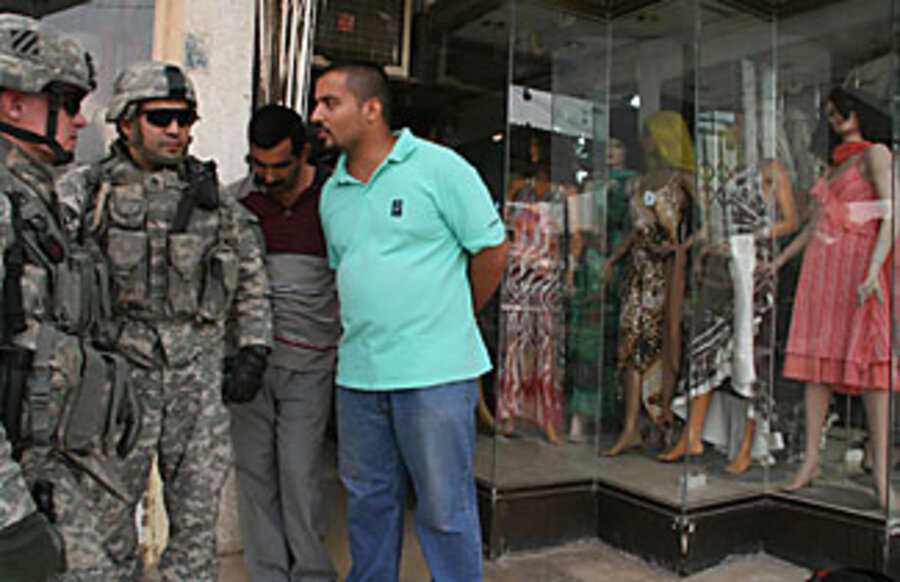
At COP Adel, a battered shopping center now barricaded with giant walls and nicknamed "the mall," soldiers from the 1/64 recently milled around in front of their Humvees. Inside, others nibbled on hot meals trucked in from Camp Liberty, the battalion's headquarters within the sprawling US command complex next to Baghdad's airport. A few pump iron, some mop up, others surf the Internet.
"They tell us we are doing something for our country, but I do not see it," says one soldier, who did not want to have his name published. "It seems more like the real fight is in Afghanistan … instead they get us into this [area of operation], which is more like Mr. Rogers' neighborhood."
Adel, a once-prosperous middle-class area, is now almost all Sunni and poor. Shiites fled the sectarian violence of 2006 and their homes have been occupied by Sunnis displaced from neighboring Hurriya. That shift is just one example of the new sectarian segregation throughout Baghdad.
Many average Iraqis in Adel, as well as in the areas of Jamiaa, Iskan, Khadra, Washash, and parts of Mansour, where the 1/64 operated, give credit to the US for the turnaround in their western Baghdad neighborhoods. But they fear a return to the not-so-distant days of lawlessness should US troops leave soon. The 1/64 is being replaced with another unit.
On a recent house-to-house search in Adel by members of the 1/64, accompanying Iraqi soldiers seemed more interested in chatting and texting on their cellphones than the mission at hand.
"It's tiring. It has been five years. Now it's called knock-and-search instead of raids. A lot of the [Iraqi] soldiers do not want to do their jobs," grumbles Staff Sgt. Jose Benavides from Miami. "If the Americans leave, the sectarian violence will flare up."
In one stately Adel villa, Iman Marouf says she's "guarding" the house for its absent Shiite owners. No Shiites have dared return to the neighborhood since a bombing last month targeted some who had come back.
"Fear consumes people. Hearts are still filled with fear," says Mrs. Marouf, gesturing emotionally.
Her sister, Jinan Marouf, adds: "All this calm is temporary, trust me. If we get someone like Saddam Hussein back, Iraq will be itself again. We need someone with his control."
From the Adel outpost, the soldiers served as cop, community benefactor, and mentor to Iraq's fledgling security forces.
On a recent drive with Lt. Col. Edward Chesney, the 1/64's commander, through his area of operation, he recounted how the local Iraqi police unit was rebuilt from scratch in many of the mainly Sunni neighborhoods he oversees. It's now staffed with men, some ex-insurgents, mostly on the US payroll.
He spoke of how commercial thoroughfares are being slowly revitalized with US grants to shop owners and of the public-works projects initiated and paid for by the US military.
He described with enthusiasm how US funds are being spent on creating municipal outposts, known as public-works substations, in many of these once no-go neighborhoods to encourage the Shiite-led Baghdad municipal authorities to pitch in.
But when it comes to broader Iraqi reconciliation, he says, that's something you can't impose. "That's something they are going to have to work through," he says. "I think foundations have been laid in our areas, but if progress does not continue there is potential for things to unravel again."
The toll of multiple tours
At the 1/64's headquarters inside Camp Liberty, framed photos pay tribute to the 12 US soldiers and one Iraqi interpreter that the unit lost during its deployment in Iraq.
Among them is Maj. Sid Brookshire, from Willard, Mo., who died June 20, 2007, when his vehicle hit a roadside bomb. Five soldiers and one interpreter died March 10, 2008, when a suicide bomber attacked them. They had been conducting an "economic assessment" in a Mansour market in order to provide local shopkeepers with grant money.
The losses quickly took their toll on the men and women of the unit, many who had already served several tours.
"At first I was shocked, because we had not had a casualty in six months. People were talking already about going home," says the unit's public-affairs officer, 1st Lt. Tabitha Hernandez, from Wellsville, N.Y. "The worst part for me was seeing grown-up men cry."
She says the March attack was a "hard hit" for the platoon to which the dead officers and soldiers belonged and the battalion as a whole, which comprises a core force of about 830 plus an attachment of about 170.
Lieutenant Hernandez says nearly 40 percent of the battalion's members are in Iraq for a third time since the start of the war in 2003. "It's astronomical," she says.
For Sgt. Mark Martin, a father of three from Chatsworth, Ga., on his third tour, the toll of the multiple and almost back-to-back deployments for many units is grueling. "We are so stretched that constantly, if we are not training back home, we are here."
And many within the battalion wonder just how long the war will – or should – go on.
Maj. Chris Budihas recalls how in 2004 – while he was serving in Najaf to the south – he had asked the commander of US troops in Iraq at the time, Lt. Gen. Ricardo Sanchez, whether there would be an Operation Iraqi Freedom (OIF) 12 or 13, the US military's term for tours of duty in Iraq.
"He looked down, shifted the sand with his boots, and told me 'maybe'," says Major Budihas, who is finishing up his 17-month tour as part of OIF 6.
In 2007, Budihas, of Jacksonville, Fla., had already been in Iraq for three months working at division level in Baghdad but was seconded to the 1/64 after it lost Major Brookshire.